
SpaceX raised $75B to build rockets. It's now the landlord of frontier AI.
SpaceX Raised $75 Billion to Build Rockets. It’s Now the Infrastructure Backbone of Every Major AI Lab.
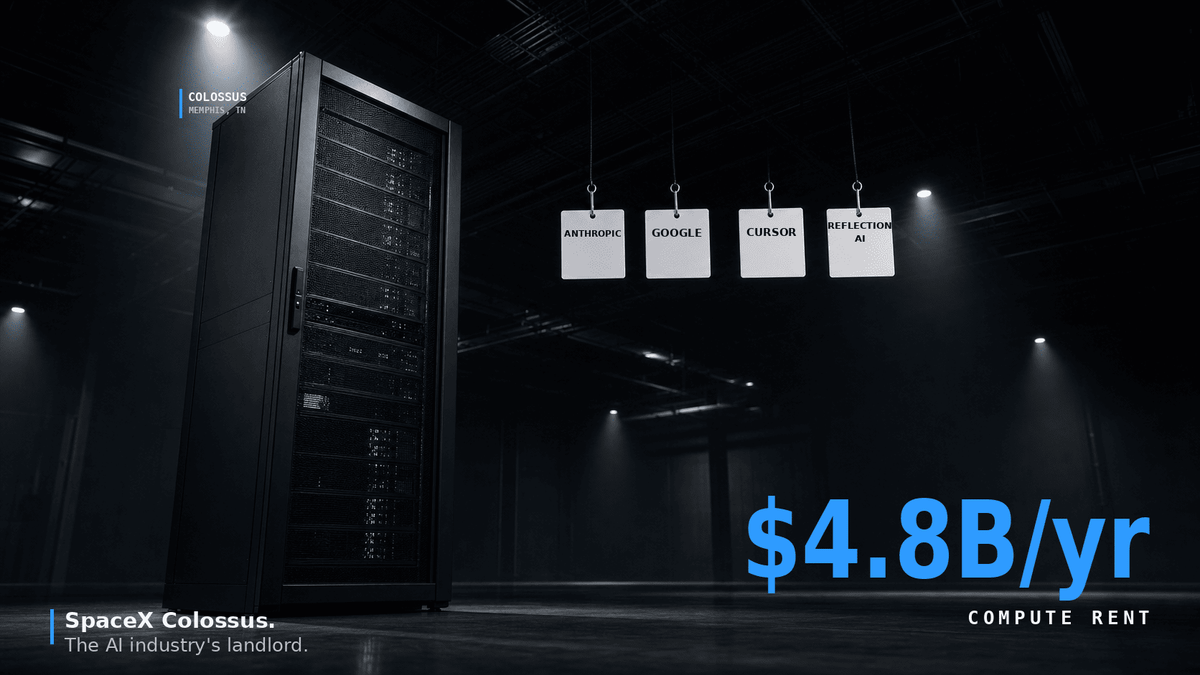
SpaceX signed a $6.3 billion compute deal with Reflection AI on June 22 — the fourth major outside AI company to pay for time on Colossus, Elon Musk’s supercomputer campus in Memphis, Tennessee. Anthropic is paying $1.25 billion per month. Google has a deal. Cursor is locked in. Now Reflection AI is committed to $150 million per month through 2029. The company that IPO’d two weeks ago as a rocket manufacturer is quietly becoming the AWS of frontier AI. And Colossus — which started as an internal GPU cluster for Grok — may generate more revenue this year than SpaceX’s launch business.
THE STORY
When SpaceX filed its S-1, the conversation centered on three business segments: launch, Starlink, and the xAI division that was burning $6.35 billion annually. Wall Street priced the launch business as stable, Starlink as the profit engine, and xAI as the expensive bet.
Nobody modeled Colossus as a profit center.
That was a mistake.
Project Colossus is SpaceX’s supercomputing campus in Memphis, Tennessee, built initially to train Grok — xAI’s chatbot — on what Elon Musk called a “gigafactory of compute.” The initial buildout reached approximately 100,000 Nvidia H100 GPUs. Musk described it as the largest single cluster of training compute on earth at the time of its completion. It has since expanded to roughly 555,000 Nvidia GPUs across multiple generations, including GB300s — Nvidia’s current top-of-the-line training chips.
To put that scale in context: Amazon Web Services operates approximately 3 million servers across its global infrastructure. Colossus is a single campus approaching the compute density of a significant fraction of AWS’s AI-relevant capacity in one location.
The Reflection AI deal, confirmed by CNBC on June 22, commits the startup to $150 million per month beginning July 1, 2026, through 2029 — a total commitment of up to $6.3 billion. Reflection is valued at $25 billion and has yet to release a public frontier model. It is paying SpaceX $150 million per month for the compute capacity to build one.
Reflection is the fourth major outside tenant on Colossus. Anthropic expanded its compute arrangement with SpaceX to approximately $1.25 billion per month through 2029 — announced in May 2026 before the Fable 5 ban. Google has a deal. Cursor, now wholly owned by SpaceX, is integrated into the infrastructure. The pattern is unmistakable: SpaceX acquired xAI, which gave it Colossus. And Colossus is now rented to the rest of the frontier AI industry.
A Reflection spokesperson framed the deal explicitly in the context of the Fable 5 ban: “Recent events highlight how important open source is to the AI ecosystem, with more nations and enterprises recognizing the risks and costs associated with exclusively depending on closed models.”
That framing is commercially precise. Reflection’s thesis — American open-weight frontier models for governments and enterprises that can’t use closed US labs for sovereignty reasons and won’t use Chinese open-weights for security reasons — gained its most important proof point from the Fable 5 shutdown. One government directive removed a closed model from service for 13+ days. An open-weight model with downloadable weights cannot be recalled.
The June 22 SpaceX deal commits Reflection to $150 million per month for GB300 capacity through 2029 — the compute commitment is the most concrete signal yet that a public model is coming. Reflection has been building toward a 2026 frontier model release. The $6.3 billion compute commitment suggests the training run is imminent.
The Colossus revenue math is worth running explicitly. Anthropic: $1.25 billion per month. Reflection: $150 million per month starting July 1. Google: undisclosed. If the four major tenants average $400 million per month in compute revenue — a conservative estimate given Anthropic’s disclosed rate — Colossus generates approximately $4.8 billion per year in external revenue alone. SpaceX’s launch business generated roughly $7 billion in 2025 revenue. The company that raised $75 billion on the premise of being a rocket company may end the year with a computing business approaching the scale of its flagship product.
THE MONEY ANGLE
1. Colossus is the most underpriced asset on SpaceX’s balance sheet. SpaceX’s S-1 disclosed the xAI division as a loss center — $6.35 billion in operating losses in 2025. The market priced it as an AI moonshot. Nobody priced it as a compute landlord. At $4.8 billion in projected annual external compute revenue — against capital costs that were already sunk into Colossus’s construction — the operating economics of renting compute to Anthropic, Reflection, and Google look fundamentally different from building Grok. The bull case for SPCX is not Grok defeating ChatGPT. It is Colossus becoming the AWS of frontier AI training, with four of the five most important frontier AI labs as paying tenants. That case is now supported by four disclosed or reported customer relationships.
You’re not late, you’re just early to the wrong layer. A lot of people see a story like this and think one of two things: “I missed it.” Or: “It’s too obvious.” But the market doesn’t always work like that. Sometimes the headline isn’t the opportunity. It’s the signpost. And that’s exactly what may be happening with SpaceX right now. Because the real story may not be the IPO itself… It may be the hidden company tied to Elon’s plan to solve AI’s biggest bottleneck. That’s where things start to get interesting. Because if the IPO pulls the whole sector into focus, some investors won’t be looking at SpaceX first. They’ll be looking at what sits behind it. Watch the briefing before June 30. Don’t get left behind. (ad from Weiss Ratings)
2. Reflection AI at $25 billion is the most interesting uninvestable story in AI right now. Reflection has raised $4.5 billion, committed $6.3 billion in future compute payments, and has not shipped a single public model. Its valuation has gone from $545 million to $25 billion in under a year — 46x. Its investors include Nvidia ($800 million), JPMorgan, Sequoia, Lightspeed, and Eric Schmidt. Its founders built AlphaGo and led Gemini’s reward modeling. The thesis — American open-weight frontier AI as the alternative between closed US labs and Chinese models — is strategically coherent and directly supported by the Fable 5 shutdown. The risk: zero shipped products, a $150 million per month compute bill starting July 1, and a frontier model race where the leaders are shipping multiple major updates per year. If Reflection’s first model is not frontier-class on release, the thesis collapses. Watch for the model release announcement. It will be the most important AI launch of Q3.
Think SpaceX is Musk’s “Moonshot”? Think again. According to tech expert Jeff Brown, SpaceX and Tesla were just the “testing grounds” for Musk’s real masterpiece. He’s building a “General Purpose Intelligence” company — one that powers every Cybercab on the road and every robot in the factory. It’s the “Brain” of the future. And while the public is “sick and tired” of hearing about the SpaceX IPO, the smart money is moving into this secret robotics play. See the “Brain” company details here. (ad from Brownstone Research)
3. The sovereign AI market is the $500 billion opportunity that every SPAC in 2023 missed. Gartner estimates sovereign cloud IaaS spending at $80 billion in 2026. McKinsey argues that 30–40% of global AI spending will be shaped by sovereignty requirements by 2030 — implying a $500–600 billion market across compute, models, and deployment. Every government that watched a US export directive remove Fable 5 from service within four hours is now actively evaluating whether closed US frontier models are viable for sensitive sovereign use. Reflection’s pitch — American, open-weight, auditable — is precisely calibrated to that demand. White House AI Czar David Sacks posted: “It’s great to see more American open source AI models. A meaningful segment of the global market will prefer the cost, customizability, and control that open source offers. We want the U.S. to win this category too.”
THE OPPORTUNITY
1. SpaceX’s compute revenue is the number to watch in the September earnings report. SpaceX’s first public earnings report is scheduled for September 2, 2026. Analysts will be focused on Starlink subscriber growth, launch revenue, and Grok MAUs. The number that will actually determine whether the SPCX bull case is intact is external compute revenue — how much Anthropic, Google, Reflection, and other tenants paid Colossus in Q2 and Q3. If that line is approaching $1 billion per quarter, the SpaceX compute business is on a trajectory to rival Starlink as a profit center within 18 months. That number is not yet in any consensus model. Investor move
2. Reflection’s first model release is the most important AI event of Q3. When Reflection ships its first public frontier model — expected before year-end — it will be the first American open-weight model competitive with GPT-5.5 and Fable 5. The first 72 hours of benchmarks will determine whether the sovereign AI thesis is real or theoretical. Set a Google Alert for “Reflection AI model release” and “Asimov model.” The release will move the entire open-weight AI category — Meta’s Llama strategy, Mistral’s positioning, and every enterprise currently evaluating open-weight alternatives to closed APIs. Investor move | Business owner move
3. If you’re evaluating open-weight models for enterprise deployment — the landscape shifts in Q3. The open-weight AI market in June 2026 is dominated by GLM-5.2, Llama 4, and Mistral Large — all capable but none at the frontier capability level of Fable 5 or GPT-5.5. If Reflection ships a frontier-class open-weight model in Q3, every enterprise currently accepting a capability discount to run open-weight models for sovereignty or cost reasons gains access to frontier capability without closed-model dependency. Map your current open-weight deployment gaps now, so you can evaluate Reflection’s model against specific production requirements on release day rather than spending six weeks on discovery. Business owner move
QUICK HITS
Gemini 3.5 Pro: Six Days Left on Google’s Self-Imposed Deadline Sundar Pichai committed explicitly at Google I/O on May 19 to a June 2026 launch for Gemini 3.5 Pro. Polymarket currently prices 50–55% probability of a June 30 general availability. With six days remaining, the community is split between those expecting a late-week launch and those expecting a July slip. The model’s confirmed specs: 2-million-token context window, Deep Think reasoning mode gated to $250/month Ultra subscribers, and expected pricing of $15 per million input tokens and $60 per million output tokens. ◆ Money angle: Gemini 3.5 Pro is the only major frontier model launch that could reset the competitive narrative before the OpenAI IPO roadshow begins. If it slips to July, Google hands OpenAI another two weeks of benchmark leadership in the enterprise sales cycle.
OpenAI Ships GPT-5.5-Cyber — Gated to Eight Security Partners OpenAI launched GPT-5.5-Cyber on June 22 as part of its Daybreak cybersecurity initiative. The model achieved 85.6% on CyberGym (vs 81.8% for standard GPT-5.5) and 39.5% on ExploitGym (vs 25.95%). It is gated to vetted organizations through the Trusted Access for Cyber program, which includes Akamai, Cisco, Cloudflare, CrowdStrike, Fortinet, Oracle, Palo Alto Networks, and Zscaler. ◆ Money angle: A cybersecurity-specialized model gated to eight named enterprise partners — all publicly traded — is an enterprise sales pipeline announcement dressed as a product launch. Each of the eight partners now has a competitive differentiation story to sell to their customers. Watch for Palo Alto Networks and CrowdStrike to reference it in next earnings calls.
A Lawsuit Just Named Fable 5’s Shutdown as Tortious Interference A San Jose legal-tech startup filed suit against the US government, arguing that the June 12 Fable 5 export control directive constituted tortious interference with its commercial AI contracts. It will not be the last. The case establishes the legal theory that third-party businesses — not just Anthropic — have standing to sue the government for commercial damages caused by model shutdowns. If the theory holds, the liability exposure for future unilateral AI export directives grows substantially. Every government lawyer writing the next directive now has to model third-party litigation risk. ◆ Money angle: If the tortious interference theory survives a motion to dismiss, it creates a litigation backstop that constrains the government’s ability to issue future Fable 5-style directives without advance notice and due process. That constraint is worth real money to every enterprise dependent on frontier AI APIs.
Jeff Brown predicted the SpaceX IPO… Long before it was the biggest investment story of 2026. He backed Tesla when others said it was going broke. It’s up 1,800% since. Now, he says Musk is starting a virtually brand-new company… From the ground up. And estimates are it could be 14 times bigger than SpaceX. Click here to find out how to claim a stake in Elon’s secret $25 trillion IPO — today. (ad from Brownstone Research)
The company that raised $75 billion to build rockets is now collecting $1.25 billion per month from the AI lab whose model the US government shut down two weeks ago — while simultaneously building the compute infrastructure for the startup that exists because that model got shut down. The money flows in AI are not linear. They are circular. And the circles all run through Memphis, Tennessee.
See you tomorrow, The Future Geek Team