The G7 seating chart that tells you everything about the AI power race.
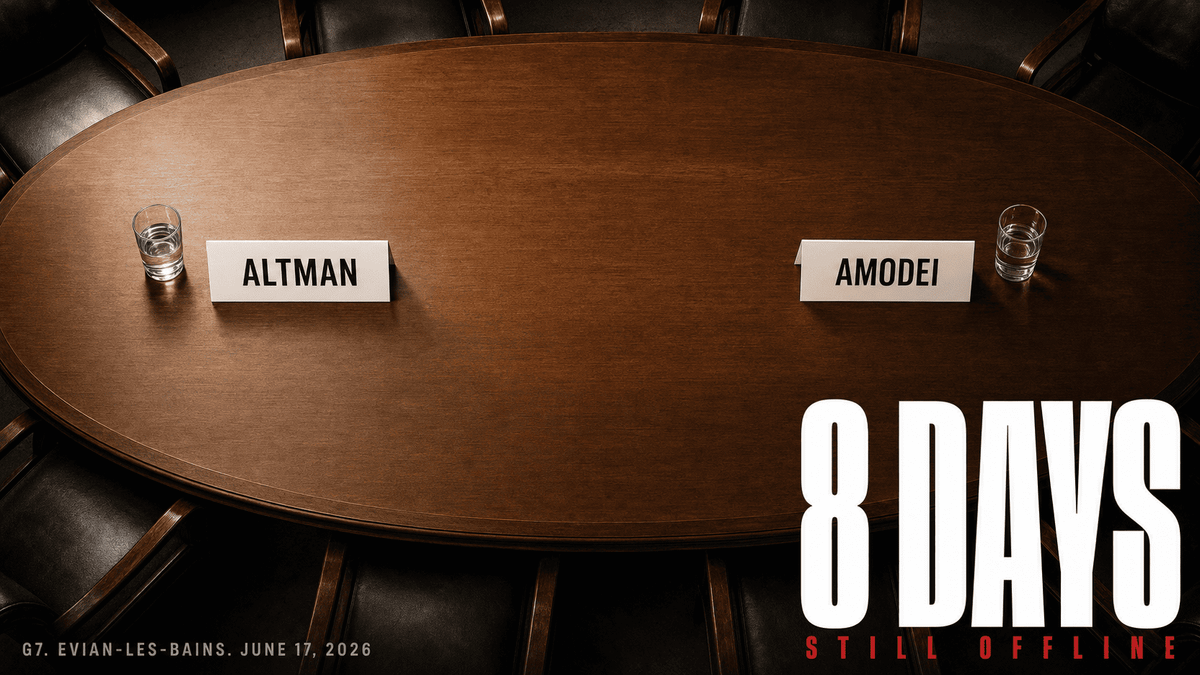
Eight days after the US government shut down Anthropic's flagship models, President Trump told Axios: "Not now, but a week ago, maybe." The threat designation is gone. The export controls are not. Fable 5 remains offline. The refund deadline is today. And the most revealing image of the week was the seating chart at the G7 AI lunch in Évian-les-Bains — Sam Altman at Trump's side, Dario Amodei across the room next to Emmanuel Macron. The crisis is moving toward resolution. The competitive damage is already done.
THE STORY
The G7 summit in Évian-les-Bains, France was supposed to be about trade. Instead it became the most consequential meeting in AI geopolitics since the first executive orders on artificial intelligence.
On June 17, Trump sat down for a working AI lunch with more than two dozen tech executives and world leaders. The guest list read like a who's-who of the frontier AI industry: Sam Altman, Dario Amodei, Demis Hassabis, Marc Benioff, and the founders of Mistral, Cohere, and Sakana. Commerce Secretary Howard Lutnick — the man who signed the letter that took Fable 5 offline — was also in the room, along with Treasury Secretary Scott Bessent and Secretary of State Marco Rubio.
The seating arrangement was not accidental. Altman sat directly beside Trump. Amodei sat across the large oval table, next to French President Emmanuel Macron. The visual told a story that no press release needed to explain.
Amodei used the session to issue what sources described as a pointed warning to the assembled heads of state: "resist the temptation to splinter" in how countries handle AI regulation. It was a direct shot at the fragmented, nation-by-nation approach that allowed a single US export control directive to take a commercial AI model offline for every customer on earth within four hours. Macron had already put the same point more bluntly in public: "Nobody will buy US AI if they fear it can be switched off at any moment."
The lunch produced movement. Politico reported on June 19 that Anthropic and the US government are actively working toward a deal to restore Fable 5 and Mythos 5 access — one that would also see both parties jointly develop a framework for evaluating dangerous AI capabilities. That framework is the structural concession Anthropic is making: it is agreeing to let the government help define what "too dangerous" means, in exchange for getting its models back online.
Then on June 20, Trump gave his clearest signal yet. Asked whether Anthropic or Amodei was a national security threat, he said: "Well, not now, but a week ago, maybe." He described Amodei as "nice" and "smart" after the G7 lunch. He praised Anthropic's compliance: "He responded to us very quickly because you know it's a tremendous liability. People get put in prison immediately for that. You can't play games with that. And he responded very responsibly, I thought."
What Trump did not do is lift the export controls. The Commerce Department's June 12 directive remains in place. The Defense Department's March supply-chain risk designation has not been withdrawn. The federal ban on government agencies using Anthropic technology continues. Fable 5 is still offline as of this writing. The refund deadline for affected subscribers is today — June 20.
The gap between Trump's rhetoric and the actual regulatory posture is the story. A president who says "not a threat" while leaving every enforcement mechanism intact is either waiting for a deal to close before announcing the resolution, or using the softened language as leverage to extract the joint capability framework Anthropic is now apparently willing to provide.
Fortune's reconstruction of the week reveals one more detail that reframes everything: the NSA was actively pushing for emergency export controls on Fable even before the model launched on June 9. The SK Telecom access issue and Amazon's jailbreak report did not create the concern — they accelerated it. The national security establishment had already decided Mythos-class models required export control. Fable 5's launch just set the clock.
THE MONEY ANGLE
1. "Not a threat" without lifted controls is a negotiating position, not a resolution. Trump's language softened. The regulatory infrastructure did not. Investors pricing an Anthropic IPO at $965 billion need to understand the difference between a president calling a CEO "smart and nice" at a summit lunch and the actual removal of supply-chain risk designations, export control directives, and federal agency bans. All three remain active as of today. The IPO roadshow cannot begin until at least the most visible of those restrictions — the global Fable 5 suspension — is resolved. Every day that gap persists is a day the S-1 narrative includes "company currently unable to serve its flagship product to any customer."
2. The seating chart is a $1 trillion competitive signal. Altman sat next to Trump. Amodei sat next to Macron. That arrangement — whether deliberate or coincidental — reflects the actual state of each company's relationship with the current US administration. OpenAI has maintained a cooperative posture with the Trump White House since January. Anthropic has been in active litigation with the Defense Department since March. At the moment the most important AI policy conversation of the year was happening, OpenAI's CEO had the president's ear and Anthropic's CEO was building a coalition with European leaders. Both strategies are rational. They produce different near-term outcomes for US government contracts, federal procurement, and regulatory treatment. That difference is now priced into the IPO gap: OpenAI targets $850 billion–$1 trillion. Anthropic targets $965 billion. The government relationship risk is one reason analysts give OpenAI the higher probability of hitting its target.
3. The joint capability framework is the real price of Fable 5's return. Anthropic is reportedly agreeing to co-develop a framework with the US government for evaluating dangerous AI capabilities — the structural concession that gets Fable 5 back online. That framework, once established, becomes the compliance template every other frontier AI company will be required to follow. The company that writes the rules gains an implicit advantage: its models are designed around the evaluation criteria it helped create. If Anthropic survives this crisis and emerges as the co-author of the US government's frontier AI safety standard, the long-term competitive value of that outcome dwarfs the short-term cost of eight days offline.
THE OPPORTUNITY
1. Watch for the official deal announcement — it is the Anthropic IPO green light. The sequence that restores Fable 5 will likely include: Commerce Department lifts or modifies the export control directive, Anthropic announces a nationality verification or trusted-partner access framework, and both parties announce the joint capability evaluation program. When all three happen — possibly in a single joint announcement — Anthropic's IPO timeline un-freezes. That announcement is the starting gun for the roadshow. Investors who understand the negotiation structure can identify the signal before the press release drops. Investor move
2. Macron's warning is Europe's AI sovereignty trade. "Nobody will buy US AI if they fear it can be switched off at any moment." That line from Macron is not rhetorical — it is a procurement signal. European governments and enterprises are now formally evaluating AI supply chains for kill-switch risk. The direct beneficiaries: Mistral (French, sovereign, open-weight), Cohere (Canadian enterprise), and any AI provider whose models can be deployed on-premises without dependency on a US export control regime. If you run a business outside the US that depends on frontier AI APIs, this week's events are the clearest possible argument for a multi-vendor or local-deployment strategy. Business owner move | Investor move
3. The joint capability framework will become the industry standard — build toward it now. Whatever Anthropic and the US government agree on as the evaluation criteria for dangerous AI capabilities will become the de facto compliance template for every frontier AI company operating in the US market. Companies that begin aligning their AI governance programs to that standard now — before it is officially published — will be ahead of competitors who wait for the Federal Register notice. The framework will almost certainly require: documented capability evaluations, red-team testing logs, partner vetting procedures, and nationality-aware access controls. All four are buildable today without waiting for the official standard. Business owner move | Founder move
QUICK HITS
Today Is the Fable 5 Refund Deadline June 20 is the refund processing cutoff for subscribers who paid for Fable 5 usage credits between June 9 and June 14. Affected customers who have not yet filed for refunds have until end of day today. The June 22 free-trial window closure follows in two days — after which paid subscription users will need separate usage credits to access Fable 5 once it returns. ◆ Money angle: Anthropic is processing real cash refunds while simultaneously negotiating a deal to restore the product. The out-of-pocket cost of the shutdown is measurable and will appear in Q2 financials — the first quarter Anthropic had projected would be its first profitable one.
Macron's Kill-Switch Warning Goes Global French President Emmanuel Macron's statement at the G7 — that no country will buy US AI if it can be switched off at any moment — has been picked up by European Commission officials, Japanese trade ministers, and South Korean technology policy bodies within 48 hours. G7 leaders discussed a "trusted partners" scheme to restore allied access to restricted US AI models — a framework that would create a two-tier global AI market: allied-access models and restricted models. ◆ Money angle: A two-tier global AI market structurally advantages companies with sovereign or open-weight models — and structurally disadvantages any US frontier lab whose export classification can be changed by a single Commerce Department letter.
Reuters Institute: 10% of People Now Use AI for News Weekly According to the Reuters Institute's Digital News Report 2026, 10% of people worldwide now use AI chatbots for news every week, up from 7% a year ago. Only 4% regularly click through to original sources. For newsletter publishers, that number is both a threat and a signal: the audience is training itself to consume AI-summarized news, not original reporting. The publications that survive are the ones that provide intelligence AI cannot replicate — proprietary analysis, actionable frameworks, and original sourcing. ◆ Money angle: The newsletters growing fastest in 2026 are not summary products — they are decision-support products. The ones that tell you what to do with the news, not just what the news is.
Eight days. One seating chart. One softened quote. And every enforcement mechanism still in place. The Fable 5 crisis is not over — but its direction just changed. The question now is what Anthropic gives up to get its models back, and whether what it gives up turns out to be an asset.
See you tomorrow, The Future Geek Team