Two stories from this weekend that change how you should think about AI investing.
China Just Answered the Fable 5 Ban With $295 Billion. And Amazon Killed a Movie About Sam Altman.
The US government spent two weeks debating whether Anthropic's most powerful model is too dangerous to share with foreign nationals. China spent those same two weeks announcing a five-year, $295 billion state AI infrastructure plan — the largest government AI commitment in history. A Chinese CEO publicly declared his company will match Fable 5-class capability before Elon Musk's Q1 2027 prediction. Meanwhile, Amazon just pulled a nearly finished Hollywood film about OpenAI CEO Sam Altman — three weeks after test screenings got warm reviews, and four months after Amazon invested $50 billion in OpenAI. Both stories tell you the same thing: in 2026, AI isn't just a technology race. It's a power race. And the money follows the power.
THE STORY
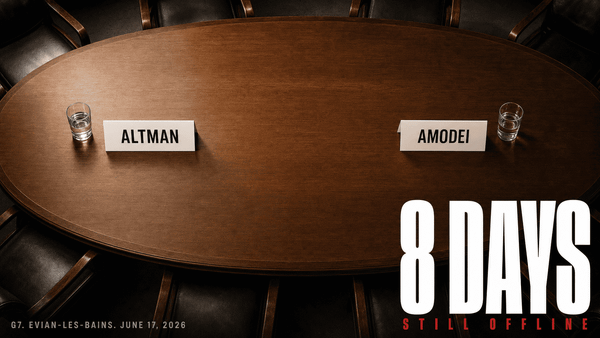
On June 12, the US government took Anthropic's most capable AI model offline. The stated reason was national security. The practical effect: every developer, enterprise, and government outside the United States lost access to the most powerful commercially available AI system — with four hours notice, and no timeline for restoration.
China watched. And then China moved.
Over the weekend, Beijing announced a five-year national AI infrastructure plan totaling $295 billion in state-directed spending — approximately $59 billion per year through 2031. The plan targets compute infrastructure, domestic chip manufacturing, AI model development, and a national grid of government-accessible AI systems. The announcement came with a pointed statement from the CEO of one of China's leading AI companies, who said publicly that his company would reach Fable 5-class capability before Elon Musk's Q1 2027 timeline.
The $295 billion figure is worth contextualizing. Goldman Sachs projects total global AI capital expenditure of $7.6 trillion between 2026 and 2031. China's five-year plan represents roughly 4% of that total — but unlike the US figure, which is driven by private companies spending their own capital, China's number is state-directed, coordinated, and immune to quarterly earnings pressure. When a government commits $59 billion per year to a technology sector, it doesn't stop because one quarter disappointed.
The Fable 5 ban was supposed to protect American AI supremacy. The policy that was designed to keep the most capable models away from adversaries may instead be accelerating the adversaries' domestic development. Every week Fable 5 stays offline, the developer community tests alternatives. GLM-5.2, the model from China's Zhipu AI, now leads GPT-5.5 on FrontierSWE benchmarks — and costs 6.8 times less per output token. It carries an MIT license with no regional restrictions. The ban created demand for Chinese alternatives and gave those alternatives two weeks of enterprise trial periods that money couldn't buy.
The Economist's June 20 cover story — "America's AI Power Grab" — framed the Fable 5 ban as a deliberate geopolitical assertion, treating frontier AI like weapons systems under export control. If that framing holds, China's $295 billion response is the logical consequence: if the US is going to weaponize AI access, China needs its own weapons. The race has officially moved from benchmark competition to state-level industrial policy.
The second story of the week is quieter — but in some ways more revealing.
In November 2025, Amazon MGM Studios acquired the rights to "Artificial" — a Social Network-style drama about the founding and fracturing of OpenAI, directed by Luca Guadagnino and starring Andrew Garfield as Sam Altman, Monica Barbaro as Mira Murati, and Yura Borisov as Ilya Sutskever. The film completed production. It went through multiple test screenings. The audience reactions were reportedly warm.
Last week, Amazon dropped it.
The official statement: "We believe that Artificial will be better served if it were released by a different studio." CAA is now shopping the film to other buyers.
The context Amazon did not mention: in February 2026, Amazon announced a $50 billion multi-year strategic investment in OpenAI. The film, written by SNL alum Simon Rich, depicts Altman in an unflattering light — specifically around his November 2023 firing and rehiring by OpenAI's board. The firing scene, by most accounts the dramatic center of the film, shows a version of events that Altman has disputed publicly.
Amazon's decision to drop a nearly finished film — one it had already paid to produce and tested with audiences — four months after committing $50 billion to the film's subject is not a coincidence. It is a preview of what $50 billion buys beyond compute capacity and API access. It buys narrative control. The story of how AI was built, who the heroes and villains are, and whose version of events becomes canonical — that story is now a financial asset being actively managed by the companies with the most to protect.
CAA will find another buyer. The film will likely be released. But the gap between "test screenings went well" and "we're dropping it anyway" is a $50 billion gap — and every journalist, filmmaker, and publisher covering AI now knows exactly where that gap is.
THE MONEY ANGLE
1. China's $295 billion plan is the most important competitor signal in AI this year. The US government's export control on Fable 5 was premised on maintaining American AI supremacy by restricting access to the most capable models. China's response — state-directed spending at $59 billion per year — is premised on closing the capability gap through domestic development rather than access. Both strategies are rational. The question for investors is which one works faster. China closed the semiconductor capability gap in roughly seven years after US chip export controls. If the AI capability gap follows a similar trajectory, Chinese frontier models reach Fable 5-class performance between 2028 and 2030 — regardless of what the US export control regime does between now and then. The American premium on frontier AI stocks is partially a premium on a capability lead that has a clock on it.
2. The Amazon/Altman situation is a blueprint for how $50 billion shapes narratives. The film will be released eventually — probably by a studio without a $50 billion conflict of interest. But the delay matters. The IPO quiet period for OpenAI targets Q4 2026. A film depicting Altman's firing in an unflattering light, releasing in the same window as the OpenAI roadshow, would be an active liability for the IPO. Amazon's decision to pull it now — rather than after the IPO — is timed precisely. For investors evaluating OpenAI's $850 billion–$1 trillion valuation: the narrative management happening around this IPO is unusually aggressive. That's not necessarily a red flag. But it is a signal that the people closest to the deal are worried about perception in ways that suggest the financial fundamentals alone aren't considered sufficient.
3. GLM-5.2's pricing advantage is a structural threat, not a benchmark curiosity. GLM-5.2 costs $1.40 per million input tokens and $4.40 per million output tokens. GPT-5.5 costs $30 per million output tokens — roughly 6.8 times more. Fable 5, when it returns, will be priced at $10 per million input and $50 per million output. For enterprises running high-volume AI workloads, a 6.8x cost difference on output tokens is not a marginal consideration — it is a budget-line decision. The two weeks of forced enterprise trial that the Fable 5 ban created for GLM-5.2 may have permanently shifted the cost sensitivity calculus for a segment of the market. Chinese model pricing is not a feature. It is a competitive strategy backed by $295 billion in state infrastructure.
THE OPPORTUNITY
1. Map your AI spend against GLM-5.2's pricing before Fable 5 returns. Before Fable 5 comes back online and the urgency of alternatives fades, run the math on your current AI API costs against GLM-5.2's pricing. For teams spending more than $10,000 per month on AI inference, the output token cost difference between a US frontier model and GLM-5.2 is likely material. The decision to stay on a US model for reliability, compliance, and geopolitical resilience is legitimate — but it should be an informed decision, not a default one. Know what you're paying for the premium. Business owner move
2. The "narrative control" premium is now a real IPO variable. Amazon's decision to drop the Altman film is the most concrete evidence yet that the companies surrounding OpenAI's IPO are actively managing the information environment around the offering. For investors doing diligence: seek out sources that don't have a $50 billion conflict of interest. The S-1, when it goes fully public, is the most reliable document — but even S-1s are written by lawyers with a mandate to present the best available case. The counter-narrative — the one Amazon just paid to suppress — is worth finding before the roadshow. Investor move
3. China's five-year plan creates a new category of investable AI infrastructure. The $295 billion Chinese state AI plan will flow through specific channels: domestic GPU equivalents, data center construction, energy infrastructure, and model development. Companies that supply the physical layer of AI infrastructure in China — including non-US semiconductor equipment vendors, power infrastructure providers, and data center construction firms — are direct beneficiaries of state-directed spending that doesn't depend on quarterly earnings. For investors with exposure to international markets, the Chinese AI infrastructure buildout is the closest structural analog to the US hyperscaler capex cycle — with the difference that it is backstopped by sovereign spending rather than private capital. Investor move
QUICK HITS
OpenAI Launches 300,000-Partner Network Before IPO OpenAI announced the OpenAI Partner Network — a certified ecosystem targeting 300,000 implementation and reseller partners globally. The timing is deliberate: the partner network creates a distribution moat that cannot be replicated quickly, builds recurring revenue streams from implementation services, and gives the IPO roadshow a metric that isn't dependent on model quality. Anthropic launched its own Claude Partner Network on June 3. Google's Cloud partner ecosystem has been operational for years. ◆ Money angle: A 300,000-partner network built before the IPO is worth more as a valuation input than any benchmark score. Distribution moats compound. Benchmark leads don't.
ChatGPT Outscores Doctors — OpenAI's Healthcare Bet OpenAI published results showing GPT-5.5 Instant outscores physician-written answers on standardized clinical question sets for accuracy, clarity, and completeness. No independent third-party validation was published alongside the announcement. The US healthcare market is $4.5 trillion annually. AI-assisted diagnosis, even at a fraction of that market, represents a revenue opportunity that dwarfs ChatGPT's current consumer subscription business. ◆ Money angle: The liability framework for AI medical advice doesn't exist yet. The company that navigates it first — establishing the regulatory precedent, the malpractice insurance structure, and the clinical validation process — captures the market. OpenAI is moving fast on the capability side. The regulatory side is 18–36 months behind.
Fable 5: Still Offline, Day 11 As of this morning, Fable 5 and Mythos 5 remain inaccessible globally. The June 22 free-trial window has now closed. Paid subscription access expired yesterday without the model returning. Kalshi holds at 57–67% odds of restoration before July 1–10. No official announcement from Anthropic or the Commerce Department. ◆ Money angle: Every additional day offline is a day Anthropic's Q2 revenue misses the first-profitable-quarter projection it had been building toward. The Q2 earnings report — whenever it comes — is now the first real test of how much the shutdown actually cost.
Two weeks ago, the US government shut down an AI model to protect American supremacy. This week, China committed $295 billion to building its own. The race didn't slow down. It escalated. And the money is now on both sides of a line that didn't exist a month ago.
See you tomorrow, The Future Geek Team