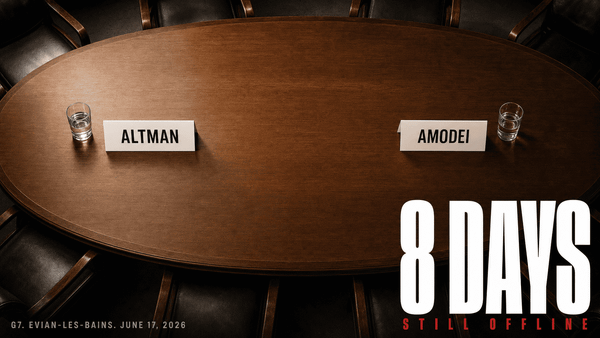
Anthropic is in Washington today. The odds are 67%. Here's the trade.
Five days after the US government pulled Fable 5 offline, Anthropic sent senior engineers to Washington for in-person talks with Commerce Department officials — the first face-to-face meeting since the June 12 directive. Prediction market traders on Polymarket give 67% odds that US customers get access back before July 1. Kalshi puts it at 58%. What nobody is pricing yet: the solution being discussed would permanently change how every AI company in America verifies its users. The Fable 5 shutdown isn't just a story about one model. It's a story about what happens when national security law meets a product that 900 million people use without showing ID.
THE STORY
The meeting happened Monday. Anthropic's senior engineers sat down with officials from the Commerce Department — the agency that issued the export control directive on June 12 — to negotiate a path back to operations for Fable 5 and Mythos 5. Tech Times described the session as "deal-seeking." No resolution has been announced. No timeline has been committed. The June 22 deadline — the date Anthropic's free access promotion for Pro, Max, Team, and Enterprise subscribers expires — is now five days away, and the model is still offline.
The shutdown has already cost Anthropic real money. The company launched Fable 5 free to all subscribers through June 22. Those subscribers paid for access they didn't receive. Refunds are now live for customers who joined between June 9 and June 14. The June 20 deadline to claim them is three days away.
The broader negotiation is about something more structural than one model. The export control directive cited "deemed export" logic — a legal framework that treats sharing technology with a foreign national on US soil the same as exporting it abroad. Under that logic, any AI model powerful enough to be classified as a controlled technology cannot be freely deployed to an anonymous public. You have to know who you're deploying to.
That creates a compliance problem that doesn't exist anywhere in the current consumer AI stack. Claude, ChatGPT, Gemini — none of them collect citizenship or nationality information from users. They collect email addresses. The "deemed export" framework, if applied consistently, would require frontier AI providers to implement something like the Know Your Customer verification that financial institutions and infrastructure-as-a-service providers already use. Forrester Research called it this week: "This could usher in the era of KYC for AI access across enterprise and commercial subscriptions."
The path Anthropic is most likely negotiating is a tiered access model: US-only access restored quickly for verified domestic users, followed by a longer-timeline process for international access that involves nationality verification at the account level. Prediction markets give 43% odds that Fable 5 will be re-enabled for non-American users before July 1 — meaning the market believes US restoration happens faster than global restoration, which implies a nationality-gated solution.
The scale of that engineering challenge is not trivial. Anthropic has users in over 150 countries. Building a real-time nationality verification system — one that satisfies the Commerce Department's "deemed export" standard — while maintaining the consumer experience that drove 47 billion dollars in annualized revenue requires infrastructure Anthropic doesn't currently have. The 28% odds that Manifold markets give for KYC being in place before June 22 suggest the developer community is skeptical it moves that fast.
Meanwhile, the competitive clock is running. Every day Fable 5 is offline, enterprise customers are evaluating alternatives. The developer community has largely shifted to OpenRouter Fusion, GLM-5.2, and Kimi K2.7 as interim options. Microsoft removed Fable 5 from its internal Copilot stack. Satya Nadella weighed in publicly on the structural implications — declining to name Anthropic specifically but calling government-mandated AI shutdowns "a new category of vendor risk that every enterprise needs to price."
Dario Amodei's position remains firm: the jailbreak cited by the government is narrow, non-universal, and available in identical form from GPT-5.5 without any bypass. The administration's position, stated by David Sacks, is that Anthropic was offered a choice — fix the jailbreak or pull the model — and refused both. The in-person meeting this week is the first sign that one or both sides are looking for a third option.
THE MONEY ANGLE
1. The prediction market is the most honest price discovery in this story. Polymarket traders give 67% odds on US restoration before July 1. Kalshi traders give 58%. Those numbers reflect real money being wagered on a real outcome. The gap between the two platforms — 9 percentage points — reflects genuine uncertainty about whether Monday's meeting produced meaningful progress. For investors watching Anthropic's IPO timeline, these odds are a proxy for how quickly the company can resolve a material business disruption. A July 1 restoration with a KYC solution in place is a manageable story for the roadshow. A suspension that bleeds into August is a different conversation entirely.
2. KYC for AI is a $3–5 billion compliance market that didn't exist last week. If "deemed export" logic becomes the standard framework for frontier AI deployment, every AI company serving users in multiple countries will need identity verification infrastructure. The financial services industry built that infrastructure over two decades. The AI industry will need to build it in months. The companies positioned to sell it: identity verification platforms like Jumio, Persona, and Onfido — all of which already provide KYC tooling to fintechs and IaaS providers. The regulatory mandate that creates this demand doesn't require legislation. It requires one more export control directive applied to one more model. The Fable 5 case is the proof of concept.
3. The June 22 pricing deadline is the hidden pressure point. Anthropic's free access promotion expires June 22 — five days from now. If Fable 5 is not restored by then, Anthropic faces a choice: extend the free period (burning cash on a product generating zero revenue), end the promotion (angering subscribers who paid for access they never received), or restore the model under a KYC framework that isn't ready yet. None of those options is clean. The June 22 deadline is the real negotiating clock — not the Commerce Department's timeline, but Anthropic's own promotional commitment to millions of paying customers.
THE OPPORTUNITY
1. Track the prediction markets as a leading indicator. Polymarket and Kalshi are pricing Fable 5 restoration in real time with real money behind each position. If odds move sharply above 80% before an official announcement, it signals that traders with information advantage believe a deal is close. If odds collapse below 40%, it signals the negotiation has stalled. For investors watching the Anthropic IPO, these markets are the fastest available signal on a material business risk — faster than press releases, faster than analyst notes. Investor move
2. KYC identity verification platforms are the sleeper trade in this story. Jumio, Persona, Onfido, and Stripe Identity are the four most credible providers of real-time identity verification infrastructure. None of them are pure AI plays. All of them benefit from every extension of KYC requirements into new industries. If the Commerce Department's "deemed export" framework becomes standard for frontier AI, the addressable market for these platforms expands by hundreds of millions of verified users overnight. Persona is private and fundraising. Jumio is Thoma Bravo-owned and approaching an IPO window. Both are worth watching. Investor move | Founder move
3. Audit your AI vendor concentration — today. Microsoft's Satya Nadella called government-mandated shutdowns "a new category of vendor risk." He's right. Every business running core workflows on a single AI provider now has a documented, real-world example of that provider going offline in four hours with no warning. The practical response: map which business processes depend on which AI APIs, identify which have no fallback, and build at least one alternative workflow for your highest-priority use cases. This is not a theoretical risk anymore. Business owner move
QUICK HITS
Refunds, Deadlines, and the June 22 Clock Anthropic opened refunds for subscribers who paid for access between June 9 and June 14 — the window when Fable 5 was available, launched, and then pulled. The refund deadline is June 20. Separately, the free access promotion for Pro, Max, Team, and Enterprise subscribers expires June 22, creating an internal deadline that may be accelerating the pace of negotiations in Washington. ◆ Money angle: Extending the free promotion costs Anthropic real revenue. Ending it without restoration costs customer relationships. The June 22 date is the most concrete pressure the company faces — more immediate than the Commerce Department's undefined timeline.
Gemini 3.5 Pro: Five Days Away Google's Gemini 3.5 Pro — featuring a 2-million-token context window and Deep Think reasoning mode — is expected to launch before June 30. With Fable 5 still offline, Google is marketing directly to enterprise customers mid-disruption. The context window alone is four times larger than any currently available Claude model. Timing is rarely accidental. ◆ Money angle: Every enterprise that migrates to Gemini 3.5 Pro during the Fable 5 outage represents a switching cost Anthropic will have to overcome twice — once to restore the relationship, once to prove Fable 5 is worth the disruption risk.
The Great American AI Act: Still Stuck The 269-page federal AI bill introduced June 4 — which would freeze state AI laws for three years — has not moved out of committee. Colorado's original AI Act effective date of June 30 is now 13 days away. Companies that delayed compliance planning waiting for federal preemption are running out of runway. The bill's sponsor has not scheduled a markup hearing. ◆ Money angle: The companies that built state-specific AI compliance infrastructure while competitors waited for federal clarity now have a structural advantage that is 13 days from being locked in.
Anthropic's engineers are in Washington. The odds are 67%. And somewhere inside the Commerce Department, a bureaucrat is deciding whether every AI product in America needs to become a bank — complete with identity checks, nationality verification, and a compliance stack that costs nine figures to build.
See you tomorrow, The Future Geek Team