OpenAI Is Filing for a $1 Trillion IPO. It Just Killed a Product That Made $2.1 Million Total.
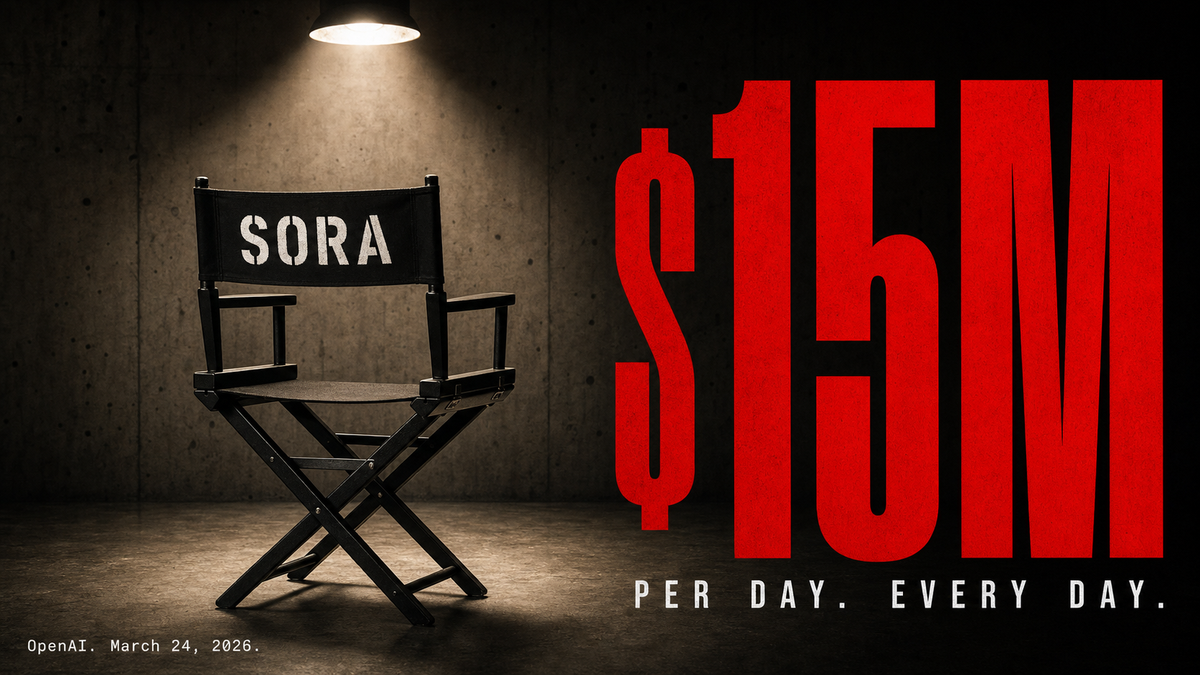
Sora was the most-hyped AI product of 2024. OpenAI shut it down on March 24, 2026 — six months after launch, three months after a $1 billion Disney deal, and after burning an estimated $15 million per day in compute costs against $2.1 million in total lifetime revenue. That math isn't a footnote. It's in the S-1. And every institutional investor reading OpenAI's IPO prospectus this fall will see it. The story of Sora is the most important warning in AI investing right now — and almost nobody is talking about it.
THE STORY
In February 2024, OpenAI showed the world a video of a woman walking through neon-lit Tokyo streets. The footage was generated entirely from a text prompt. The internet declared OpenAI had won the AI video race before it started.
Twenty-five months later, the product was dead.
OpenAI announced on March 24, 2026 that it would discontinue Sora — the app, the API, and all associated video generation features inside ChatGPT. The head of Sora, Bill Peebles, said publicly that "the economics are completely unsustainable." He then resigned, along with two other senior executives, on April 17, the same day the app went dark.
The numbers are stark. Sora burned an estimated $15 million per day in inference costs at peak usage. Each 10-second clip cost approximately $1.30 in compute — roughly 40 minutes of GPU time across four parallel processors. With millions of users generating videos daily, the daily bill compounded fast. Against that burn rate, Sora generated $2.1 million in total lifetime in-app purchase revenue, according to mobile intelligence firm Appfigures. OpenAI's daily operating cost for Sora exceeded its entire lifetime earnings — every single day.
Downloads peaked at over 6 million in November 2025, making it the fastest app to reach number one in the App Store. Then the novelty wore off. By February 2026, new downloads had fallen 45%. By the shutdown announcement, user growth had collapsed nearly 75% from peak. Competitor platforms — Kling 3.0, Runway, ByteDance's Seedance 2.0 — had advanced rapidly during the same period. A $1 billion Disney licensing deal, announced just three months before the shutdown, collapsed alongside the product.
The Sora team is now pivoting to "world simulation research to advance robotics." That is the press release. The actual story is simpler: the unit economics of AI video generation at consumer price points do not work, and OpenAI chose to kill the product before the S-1 disclosed the losses.
That last sentence is the one that matters.
OpenAI is preparing for an IPO targeting a near-$1 trillion valuation in Q4 2026. When its S-1 goes effective, it will contain audited financials. A product burning $15 million per day with minimal revenue is exactly the line item that makes institutional investors nervous. Sora's shutdown, timed three months before the confidential filing, is best understood as balance sheet cleanup ahead of the roadshow.
What remains after the cleanup: OpenAI has over $20 billion in annualized revenue, 900 million weekly active users, and a -122% operating margin. The revenue is real. The losses are larger. And the market that just valued SpaceX at $2 trillion on a -45% margin will now be asked to value OpenAI at $1 trillion on a -122% margin.
The question isn't whether OpenAI is a great company. It probably is. The question is what "great" is worth when the unit economics are this hard.
THE MONEY ANGLE
1. Sora's shutdown is an IPO signal, not a product failure. OpenAI killed a product generating zero net revenue three months before filing a confidential S-1 with the SEC. That sequencing is not coincidence. Companies preparing for IPOs clean their balance sheets. Every loss-making product line that disappears before the prospectus is one fewer question on the roadshow. Investors reading OpenAI's S-1 this fall should look specifically at what else was rationalized before filing — not just what's in the document, but what's conspicuously absent.
2. The -122% operating margin is the number that sets the IPO valuation floor — and ceiling. OpenAI's operating margin is -122%. SpaceX's is -45%. SpaceX IPO'd at 109 times revenue and closed its first day above $2 trillion. If the market applies the same multiple to OpenAI's $20 billion in revenue, you get a $2.18 trillion valuation — more than double its current target of $850 billion–$1 trillion. The actual IPO price will land somewhere between what the market thinks OpenAI can earn and what it believes OpenAI can become. The Sora shutdown made that earnings picture marginally better. Marginally.
3. The competitor that quietly won Sora's market. When Sora collapsed, the AI video market didn't disappear — it redistributed. Kling 3.0, developed by Kuaishou, and Seedance 2.0, developed by ByteDance, are now the dominant AI video platforms globally. Both are Chinese companies. Both are growing. Neither has the compute cost problem that killed Sora, because both are running on infrastructure built for Chinese domestic pricing — electricity, data centers, and GPU equivalent costs that are materially lower than US rates. The AI video market is now a Chinese-controlled market. That's not a geopolitical observation. It's a market structure observation.
THE OPPORTUNITY
1. Read OpenAI's S-1 like an auditor, not a fan. When OpenAI's full registration statement goes public — expected late summer or early fall — the three numbers that matter most are: gross margin on API revenue (not total revenue), compute cost as a percentage of revenue, and the forward-looking capital commitment to Microsoft infrastructure. The Sora shutdown tells you OpenAI is managing its cost structure for the roadshow. The S-1 will tell you how much work remains. Investor move
2. The AI video market is real — just not at OpenAI. Sora's failure was a unit economics failure, not a demand failure. Consumers want AI video. The market is growing. The viable players are Kling, Runway, and Seedance — all of which solved the cost problem Sora couldn't. If you're a business using or evaluating AI video tools, Sora's absence does not mean AI video is dead. It means the category has survivors worth evaluating. Runway raised $308 million in August 2024 and is building enterprise video pipelines. It remains the most credible US-based option. Business owner move | Founder move
3. AI-powered government enforcement is the sleeper story of 2026. While everyone watches the IPOs, the federal government quietly deployed ChatGPT to scan five years of Medicaid audit reports across all 50 states, targeting $100 billion to $200 billion in estimated annual fraud and waste. The program, called AERO, required no new legislation, no RFP, and no multi-year procurement cycle. HHS fed existing public audit documents into an LLM and started threatening funding cuts to chronic violators. This is the template for AI government enforcement — and every healthcare organization, state grantee, and nonprofit receiving federal funds should treat it as such. The states of Minnesota and California have already had funds withheld. Business owner move
QUICK HITS
The Federal Government's $150 Billion AI Audit HHS launched its AERO program in May 2026, using ChatGPT and other large language models to scan audit history from every entity spending more than $1 million per year in federal funds — covering all 50 states. HHS's assistant secretary estimated the department has between $100 billion and $200 billion in wasteful or fraudulent spending annually. The program required no new statutory authority; the audit documents were already public and sitting unread in the Federal Audit Clearinghouse. ◆ Money angle: The healthcare compliance software market just got a federal mandate it didn't need legislation to create. Any platform that helps organizations prepare for AI-powered audits is now selling into an immediate, government-created demand signal.
Goldman Sachs: $7.6 Trillion in AI Capex by 2031 Goldman Sachs projects cumulative AI capital expenditure from 2026 to 2031 at $7.6 trillion across compute, data centers, and power infrastructure — equivalent to roughly one-quarter of annual US GDP. Anthropic President Daniela Amodei cited the figure publicly at Bloomberg Tech this month as context for why the company needs IPO capital to remain competitive. ◆ Money angle: At $7.6 trillion over five years, the infrastructure layer — power utilities, data center REITs, cooling systems, fiber — is a longer and more durable trade than any individual AI company's stock.
New York Sends Seven AI Bills to Governor Hochul New York's legislature wrapped its 2026 session by sending seven AI-related bills to Governor Kathy Hochul, covering employment AI, algorithmic decision-making, and digital content authenticity. California has 30 AI bills in secondary committee review. The state-level legislative wave is accelerating regardless of federal preemption efforts. ◆ Money angle: The patchwork of state AI laws creates a compliance arbitrage opportunity — companies that build flexible, multi-jurisdiction compliance infrastructure now will have a structural advantage over those that wait for federal clarity that may never fully arrive.
The most important data point heading into OpenAI's IPO is not the valuation. It's the spreadsheet behind the shutdown — and what it tells you about the distance between AI demos and AI businesses.
See you tomorrow, The Future Geek Team