SpaceX Just Bought Your Coding Tool for $60 Billion. Four Days After Its IPO.
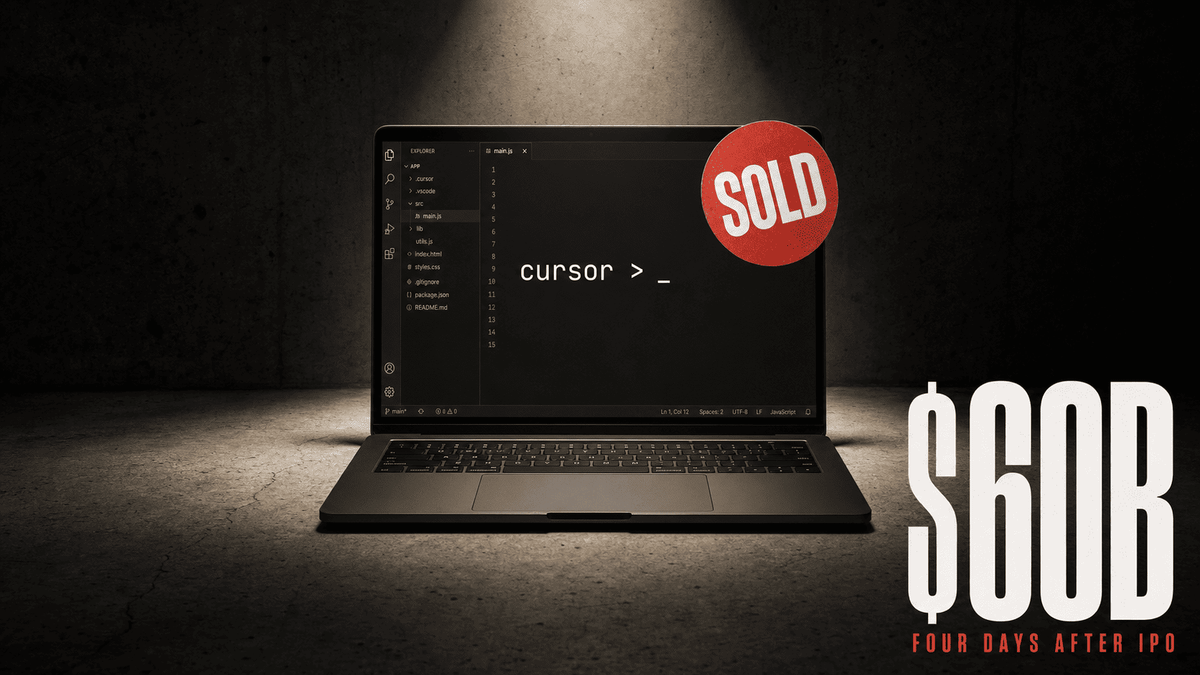
On June 12, SpaceX raised $75 billion in the largest IPO in history. On June 16 — four days later — it spent $60 billion of that on Cursor, the AI code editor sitting inside 64% of the Fortune 500. The deal is the largest acquisition of a venture-backed startup ever recorded. And it raises one question that over a million paying developers need to answer before Q3: what happens to Claude and ChatGPT access inside a tool now owned by Elon Musk?
THE STORY
Cursor went from zero to $4 billion in annualized revenue in eighteen months. That is the fastest any business software company in history has hit that milestone — faster than Slack, faster than Zoom, faster than Salesforce in its early years. Over one million developers pay for it. More than 50,000 enterprise teams run it. It is deployed inside 64% of the Fortune 500. Jensen Huang publicly listed it as one of six companies driving the digital workforce revolution.
On June 16, SpaceX signed a merger agreement to acquire Anysphere — the company behind Cursor — at an implied equity value of $60 billion, entirely in stock. SPCX jumped roughly 16% on the day of the announcement, briefly pushing SpaceX past Amazon and Microsoft by market cap. The deal is not yet closed — regulatory approval is required, with a Q3 2026 target — but the strategic logic is immediate and unavoidable.
To understand why SpaceX paid $60 billion for a code editor, you have to understand what SpaceX actually is in 2026. In February, SpaceX absorbed xAI — the company behind Grok — folding the chatbot, the X social platform, and the Memphis Colossus supercluster into a division now called SpaceXAI. That merger gave SpaceX one of the world's largest GPU installations. What it didn't give SpaceX was customers. xAI's market share in enterprise AI sits at roughly 6%, compared to Claude's 18% and significantly higher OpenAI penetration. xAI lost $6.35 billion in 2025. Musk publicly admitted xAI "was not built right the first time around."
Cursor hands SpaceX what xAI cannot build fast enough: a proven application layer with a million paying users, $2.6 billion in enterprise recurring revenue, and daily presence in the workflow of every serious software developer in America. SpaceX and Cursor have already been jointly training a new model — Grok V9-Medium — using xAI's Colossus supercomputing infrastructure for the past several months. The acquisition converts what was a training-data partnership into full ownership.
The question every developer is now asking is the same one: Cursor currently supports Anthropic's Claude models, OpenAI's GPT models, and its own Composer models. SpaceX confirmed multi-model support continues through at least the Q3 2026 expected merger close. After that, the math speaks for itself. Every API call routed to Anthropic or OpenAI inside Cursor generates revenue for a competitor and costs xAI nothing. The financial incentive to make Grok the path of least resistance is enormous and obvious.
There is a recent precedent that alarmed Cursor's own executives: Anthropic cut off API access for Windsurf, another AI coding startup, during its acquisition negotiations with OpenAI. In January 2026, Cursor held an emergency all-hands meeting and announced it must develop its own proprietary models — resulting in Composer 2.5, released in May, in which more than 85% of code was completed independently by Cursor. That backstory explains why Cursor had already begun reducing its dependency on third-party models before this deal was announced.
Microsoft had examined a potential acquisition of Cursor before SpaceX emerged. OpenAI made two separate approaches, both of which Cursor's leadership turned down. SpaceX won.
As of June 17, every major AI coding tool is now owned by a large incumbent: GitHub Copilot by Microsoft, Claude Code by Anthropic, Codex and Windsurf by OpenAI, Grok Build and now Cursor by SpaceX. The only credible independent player remaining is Tabnine. A consolidation that took traditional developer tools a decade happened in eighteen months.
THE MONEY ANGLE
1. The real acquisition price was distribution, not revenue. When a rocket company spends $60 billion on a coding tool, the strategic center has moved from model quality to compute access. AI coding tools are not a standalone business anymore — they are a distribution channel for compute companies. SpaceX paid $60 billion for a million developers who open Cursor before they open their browser every morning. That daily-habit distribution is what trains Grok V9-Medium, fills Colossus with meaningful workload, and gives xAI an enterprise foothold it could not buy with benchmarks. The revenue was the justification. The distribution was the asset.
2. The Windsurf precedent is the risk every Cursor enterprise customer needs to price. Developers who rely on Claude's code quality inside Cursor should watch post-close model pricing changes carefully. SpaceX may price Grok-based completions lower than Claude or GPT completions inside Cursor, making Grok the path-of-least-resistance default for users who do not actively choose otherwise. This mirrors the pattern Microsoft used after acquiring GitHub — Copilot's integration with Azure OpenAI accelerated at the expense of competing model providers. The question is not whether SpaceX will do this. The question is how long it takes and how aggressively.
3. Every independent AI tool just became more valuable. None of the remaining independent alternatives — Continue.dev, Zed, OpenCode — are perfect Cursor replacements today. But the market just got a massive incentive to improve. The next Cursor is being built right now by a team that watched this acquisition happen and is pitching "model-agnostic forever" as its founding principle. The seed round for that company is the trade. The incumbents just handed the positioning to whoever moves first.
THE OPPORTUNITY
1. Audit your AI tooling stack before Q3 — not after. This acquisition confirms that AI coding tools have graduated from "nice to have" to critical infrastructure. Treat AI tool strategy with the same rigor you apply to cloud provider selection, database choices, or framework decisions. Map which tools your engineering team uses daily, which models those tools route to, and what your fallback is if model access changes post-acquisition. The time to have that conversation is before the merger closes, not after your Claude access inside Cursor gets repriced. Business owner move | Founder move
2. Keep your own API keys active — independent of any IDE. Any tool that wraps a model can be replaced by direct API access. If your team's workflow depends on Claude's code quality or GPT's specific behavior, maintain direct API credentials and at least one lightweight workflow that bypasses Cursor entirely. This is not a prediction that SpaceX will immediately degrade third-party model access. It is basic vendor-risk hygiene that the Windsurf precedent makes urgent. Career move | Business owner move
3. SPCX's post-acquisition trajectory is the tell for the whole AI consolidation play. SPCX jumped 16% on the Cursor announcement. The market read it as a distribution win, not a dilution risk — which means investors are pricing SpaceX as a platform company, not an aerospace company. If Grok V9-Medium ships before the merger closes and shows meaningful coding performance improvement, SpaceX's thesis — that owning the compute, the model, and the application layer creates compounding advantage — gets validated publicly. Watch Grok V9-Medium's coding benchmarks when they drop. That number is the first real test of whether the $60 billion made strategic sense. Investor move
QUICK HITS
Every major AI coding tool is now owned by a conglomerate GitHub Copilot belongs to Microsoft. Claude Code to Anthropic. Codex and Windsurf to OpenAI. Grok Build and now Cursor to SpaceX. The only credible independent platform remaining is Tabnine. The AI coding assistant market is valued at $12.8 billion in 2026 and projected to reach $30 billion by 2032. The entire application layer is now inside conglomerate balance sheets. ◆ Money angle: The only remaining independent path — and the only one that can sell "model-agnostic forever" as a founding principle — is worth ten times more as a market position today than it was last week.
Fable 5: Day 6, clock running Washington negotiations continue. The refund deadline is June 20 — two days from now. The free promotion expires June 22. Polymarket holds at 67% odds of US restoration before July 1. No official announcement yet. ◆ Money angle: Every day Fable 5 stays offline is a day Anthropic's enterprise customers evaluate alternatives — and Gemini 3.5 Pro is about to launch into that exact vacuum.
OpenAI deploys the first near-autonomous AI chemist OpenAI and Molecule.one achieved what they believe is the first near-autonomous AI chemist in organic chemistry: GPT-5.4 and Maria AI selected the research area, generated proposals, rated them, and ran experiments in the Maria Lab. The full process took approximately 2.5 months, plus another half month for human chemists to write up the results. It is the first demonstration of a frontier model supporting the complete scientific research loop — from hypothesis to experiment to finding. ◆ Money angle: If an AI can autonomously improve reactions in medicinal chemistry, the cost of drug discovery — historically $2.6 billion per approved drug — has a structurally different floor. Biopharma companies that adopt this first don't just save time. They save capital.
Antigravity CLI replaces Gemini CLI — today Google confirmed that the Antigravity CLI replaces the Gemini CLI effective June 18, 2026. Developers who built workflows or CI/CD pipelines around the Gemini CLI need to migrate now to maintain functionality. The Antigravity CLI shipped at Google I/O 2026 and is designed for the Gemini 3.5 agentic model family. ◆ Money angle: Every forced developer tool migration is a churn opportunity for a competitor. Google is asking its developers to switch their CLI on the exact day SpaceX just made Cursor an active strategic question for every engineering team in America.
In eighteen months, every major AI coding tool went from independent startup to subsidiary of a trillion-dollar conglomerate. The consolidation ended faster than anyone predicted. The next question is what SpaceX does with what it bought — and whether a million developers stay to find out.
See you tomorrow, The Future Geek Team